

by Gabriela Lazaro
Windows Facilitator
Residential Counselor, Jewish Family Service’s Hope North Domestic Violence Shelter
Los Angeles, California
I work at Hope North Domestic Violence Shelter for Jewish Family Service Los Angeles, where I have been a Residential Counselor for eight years and an AWBW Facilitator for ten. Our program is an emergency shelter for survivors and their children who have recently left domestic violence situations. For their safety, clients leave behind homes, belongings, communities, jobs, schools, friends, and daily routines.
Many children arrive at the shelter experiencing a mix of emotions. They may not understand why they had to leave everything behind. Some feel guilty about the violence, even though it was never their fault. They may miss the abusive parent while also trying to understand what happened in their family. They miss their friends, their homes, their belongings, and the routines that once felt familiar.
When I meet children at the shelter for the first time, I often ask about their favorite art supplies and past experiences with art. I have similar conversations with the adults we serve. I ask about their experiences with art, introduce them to AWBW, and explain the purpose of the program.
I talk about how art can be used as a healing tool, where there is no right or wrong way to do it, the purpose is simply to be present and express whatever is on your heart or mind.
Some clients initially feel intimidated by the idea of participating in an art workshop. They may believe they are not artistic or worry about what they are expected to create. I encourage them to simply come and see what the art group is like. There is no pressure to create something perfect. The experience and what they discover about themselves through the process are what matter.
 Domestic violence is about power and control. Survivors may spend years being told what they can do, where they can go, who they can speak to, what they can wear, how money can be spent, or even what they should think and feel. In many cases, after living under that kind of control, making their own decisions can become difficult.
That is one reason AWBW can be so powerful. During a workshop, participants make their own decisions. They choose the colors, shapes, images, and words they want to include. They decide what their artwork means and how much of its meaning they want to share with others. These choices may appear small from the outside, but for someone whose choices have repeatedly been taken away, they have a deeper meaning.
One piece of artwork that has stayed with me over the years was created by a resident who had temporarily lost custody of her children and came to the shelter to escape the abuse.
She participated in the Mask of Abuse workshop. On the outside of her mask, she created the image of a superhero. On the inside, she placed many tiny pieces of paper in different colors.
When sharing the meaning behind her mask, she explained that she felt she needed to be a superhero for her children. When she talked to them, she would smile and try to remain calm. She wanted them to see her as strong. But on the inside, she felt broken into pieces. She felt lost, guilty, and heartbroken.
Her artwork revealed something powerful and deep. Both sides of her experience were true at the same time: she was strong, and she was hurting. Her willingness to share her story became an example of vulnerability and strength for other members of the group, and an empowering moment for her to acknowledge what she had been through.
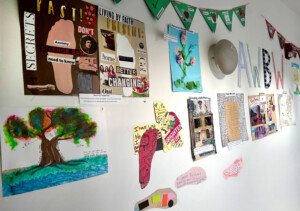
Art helps survivors understand themselves more deeply. It also gives them a way to express what can be difficult to put into words. Sometimes a person is not ready to explain an experience verbally or does not know how to describe what they are feeling. Through colors, images, shapes, textures, and symbols, those emotions have somewhere to go.
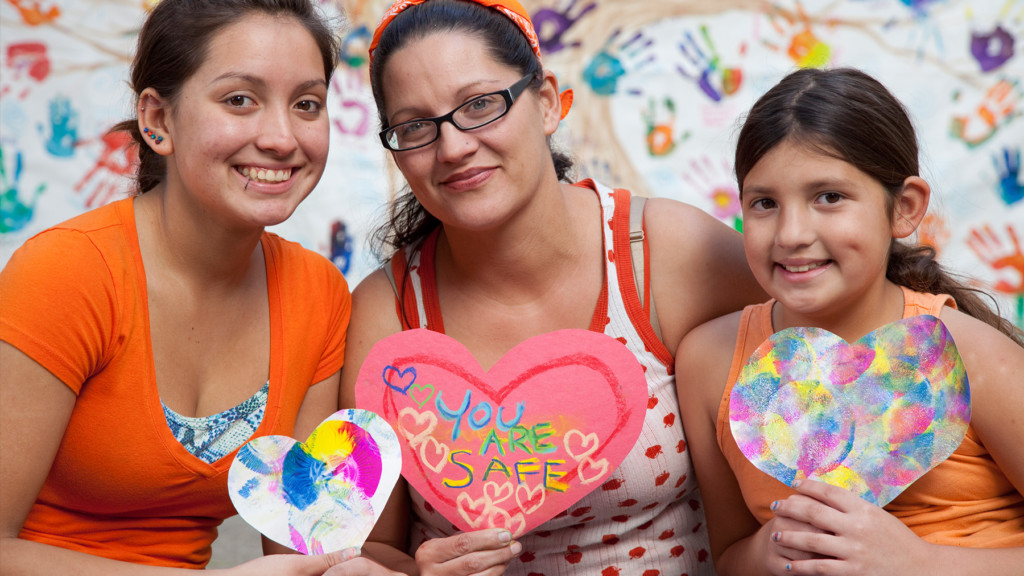
I worked with an eight-year-old boy who arrived at the shelter struggling with anger. He had a difficult time adapting to the program. At first, he didn’t show an interest in art. I continued encouraging him and before he and his family left the shelter, we did the Heart Stories workshop together. I chose this workshop because he expressed having many feelings and being frustrated about everything he was feeling. I encouraged him to listen to his heart, and let him know I wanted to validate those feelings.
He created five different kinds of hearts. The first was a sad heart because he missed his dad and did not understand why they had to leave their home. He made a green heart because he loved nature, and a pink heart because he loved his mother and sister. His orange heart was a boundary heart; he explained that he did not want bad people around him. Finally, he made a yellow heart to represent happiness; he was happy about being in the shelter, doing art, and making new friends.
Then he said something I will never forget: “If Mom wouldn’t have left our house, I wouldn’t have met you and I wouldn’t have done this fun art.”
His artwork held many emotions at the same time. He could miss his father and still recognize the need for boundaries. He could feel sadness about leaving home while also experiencing happiness in his new environment. He could love his family, miss what he had lost, and enjoy the friendships and experiences he was gaining. Art gave him enough space for all of those feelings to exist together.
 After more than a decade doing this work, AWBW remains one of the most powerful tools I have in my work with shelter residents and their children. The shelter provides physical safety, but AWBW creates another kind of safe space, a place where participants can make their own choices, express feelings they may not yet be able to put into words, and discover parts of themselves they may have become disconnected from while in survival mode.
Workshops like the Mask of Abuse and Heart Stories (Spanish version) give survivors a space to explore, on paper, something authentic to them and their experience. Something they can claim as truly their own. A way to say: These are my feelings. These are my choices.
This is my story.
by Gabriela Lazaro
Windows Facilitator
Residential Counselor, Jewish Family Service’s Hope North Domestic Violence Shelter
Los Angeles, California
Have you ever thought about what your heart would say if it could talk?
Download Heart Stories Workshop
Download Heart Stories (Spanish) Workshop
Want to bring healing art programming to your community?
A Window Between Worlds (AWBW) supports hundreds of direct service organizations across the country to incorporate creative expression into their work with trauma survivors. With this blog we uplift the voices of our art workshop facilitators and participants. We invite you to take in this perspective, notice what resonates and explore how it may fit into your life.